
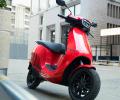
Bhavish Aggarwal, the founder of ride-hailing firm Ola who disrupted the electric scooters market in the country, is planning to launch an electric sports car in 2024. The plan will put it in competition with Indian players, such as the Tata group and Mahindra & Mahindra, and global giants like Tesla and Hyundai. Aggarwal, recently, took a group of reporters to the firm's design studio at the Ola campus in Bengaluru where his teams are working on several EVs, including scooters, motorcycles, sedans, and SUVs - and even robotaxis.

The Supreme Court, examining whether states can sub-classify the Scheduled Castes and Scheduled Tribes for the grant of a quota within a quota, said on Thursday that the state governments cannot be selective in granting reservation benefits to backward classes as it will lead to a dangerous trend of appeasement.

'In India, the GenAI startup ecosystem is unfolding with remarkable speed, signalling a new era of technological advancement and investment opportunities.'

Maruti Suzuki, Hyundai and Tata Motors reported their highest-ever dispatches to dealers last fiscal, enabling the domestic passenger vehicle industry to log in best-ever performance to date. The country's largest carmaker Maruti Suzuki India reported its highest wholesales to date at 19,66,164 units, up 19 per cent from 16,52,653 units in 2021-22. Its domestic dispatches rose to 17,06,831 units in 2022-23, up 21 per cent from 14,14,277 units in 2021-22 fiscal.Hyundai Motor India said its overall wholesales last fiscal were the highest ever since commencing operations in the country.

'Since we have a long waiting period, customers will be able to see cars for the next one year which are going to be produced and block (book) them.' 'So, if there is a wedding or a birthday in October, they can already check its availability in that month and block it.'
'Through volume numbers and unit sales one can see, we are not making a loss'

Hyderabad-based Gold Stone Group, which sells BYD buses in the country, is setting up a greenfield manufacturing facility at a cost of around Rs 200 crore

India's equity markets are on a roller-coaster ride, after delivering spectacular returns for two consecutive years - in 2020 and 2021. The benchmark National Stock Exchange's (NSE's) Nifty50 is down 1.5 per cent in the first nine months of the current calendar year 2022 (CY22) as foreign portfolio investors sold Indian stocks due to rising bond yields in the US and across global markets, including India. The sell-off in the Indian equity markets has, however, not been broad-based and largely limited to sectors facing earnings headwinds from rising interest rates, lower commodity and energy prices, and likely economic recession in advanced economies.

'What volumes will we have with a Rs 1 lakh product?' 'As a company, we will not restrict it to a segment.'

Japanese auto major Honda Cars on Thursday unveiled its new offering for the Indian market -- City e:HEV sedan, marking its foray into the mainstream strong hybrid electric vehicle segment in the country. The company, which is present in India through a wholly-owned subsidiary, has commenced the bookings of the model and plans to introduce it in the market next month. As per the company, the model, an extension of its City model range, would feature self-charging two-motor strong hybrid system connected to a 1.5 litre petrol engine, entailing a peak power of 126 PS and fuel efficiency of 26.5 km per litre.

With the theme 'Smart Mobility, Smart Cities', the company's display at the Auto Expo is focusing on intelligently-connected cities designed to offer convenience, safety, security, and efficiency to its customers.
Auto industry volumes have grown by 2.5 per cent overall, led by domestic sales of three-wheelers, two-wheelers and passenger vehicles (PVs) in the first quarter of this financial year. Analysts predict an 18 per cent growth in revenues for automotive original equipment manufacturers (OEMs) and profit growth of 69 per cent year-on-year (YoY). However, on a sequential basis, a decline in revenues as well as earnings before interest, taxes, depreciation, and amortisation (Ebitda) margins is expected.

What technologies do you fancy in your new car? Here are some popular cars in India with the most sought after technologies.

This number is more than the total number (1,071) of electric cars sold in India in calendar year 2019. MG has stopped registrations for the ZS and will cater to 2,409 of the total bookings.

If you thought electric scooters have caught the fancy of only people in the metros, think again. According to data from electric two-wheeler maker, Ather Energy, 54 per cent of its sales of scooters, starting from Rs 1.2 lakh, come from Tier 2 and Tier 3 cities. Based on sales per lakh population, the top five cities for the company are Calicut, followed by Kochi, Kolaphur, Trivandrum and Pune.

Ratings agency ICRA on Wednesday revised downwards growth forecast for the domestic passenger vehicles industry to 8-11 per cent in the ongoing fiscal from the earlier estimate of 14-17 per cent on account of the ongoing semiconductor shortage. Similarly, for the two-wheeler segment, it said the volumes are expected to contract by 1-4 per cent in FY2022 against an earlier prediction of 6-8 per cent growth as affordability and demand sentiments of target clientele was hit sharply by the second wave of COVID-19 pandemic. With around 5 lakh units of production lost by various automakers in the passenger vehicles segment due to the semiconductor shortage, ICRA said the earnings loss for the OEMs (Original Equipment Manufacturers) could be around Rs 1,800 crore to Rs 2,000 crore for the ongoing fiscal.

Passenger vehicle sales in India could hit a record of over 38 lakh units in FY23 but the strong growth momentum is not expected to carry over to 2023-24 with pent-up demand already been released, according to Tata Motors Passenger Vehicles managing director Shailesh Chandra.

Auto majors, including Maruti Suzuki India, Hyundai and Tata Motors, on Sunday reported high double-digit growth in their domestic passenger vehicle sales in July riding on stabilisation of macro-economic factors and better consumer sentiments. Similarly, Honda, Nissan, MG Motor and Skoda also reported healthy growth in their sales last month leveraging on improved market mood amid prevailing lower coronavirus infection rate, despite supply constraints of semi-conductors. The country's largest carmaker Maruti Suzuki India's (MSI) domestic sales increased by 39 per cent to 1,41,238 units last month as against 1,01,307 units in July 2020, the company said in a statement.

Maharashtra is looking for potential investment from the US electric car major Tesla in the state and has held discussions with the company, weeks after Tesla revealed its plans to enter the Indian market.

Market leader Maruti Suzuki is putting finishing touches to its plan of finding its feet in what is being hailed as a battle of epic proportions in India's fastest-growing passenger vehicle segment, reports Arindam Majumder.

India is well positioned to continue to be the fastest-growing major economy next year, which may mark the lowest global growth since the millennium began barring the pandemic and the global financial crisis, according to Tata Sons chairman N Chandrasekaran. In his New Year message to around 9.35 lakh employees of the Tata Group, he said increasing consumption, consumer confidence and investment will support India's growth story although the global environment has several risk factors, including the energy crisis in Europe, the battle to contain inflation to avoid recession, and ongoing geopolitical conflicts. "Post-pandemic, India opened up, and we have returned to living our daily lives normally, in a year that saw the nation turn 75 years old.

According to reports, by last year, the company has helped its customers save 15 per cent on costs -- around 5-6 per cent on fuel and 15 per cent on fleet utilisation through digital measures.

'I have personally been very keen on investing in lithium ion battery technology for some time.'

'It is going to be extremely rapid and anybody who is not there, be it investor, manufacturer, supplier, will miss out.'
Automobile retail sales in the country fell 18 per cent year-on-year in the 42-day long festive period this year as semiconductor shortage impacted production across companies affecting their ability to supply adequate numbers to dealer partners, FADA said on Thursday. During the period under review, barring three-wheeler and commercial vehicles, all other segments including passenger vehicles, two-wheelers and tractors were down as compared with the same period of last year. As per data collated by the Federation of Automobile Dealers Associations (FADA), total retail sales across segments stood at 20,90,893 units this festive period, down 18 per cent from 25,56,335 units in 2020.
Retail sales of passenger vehicles grew last month but the sales of two-wheeler and commercial vehicles remained low compared to the pre-COVID month of May 2019, according to automobile dealers' body FADA. On Monday, FADA said that overall auto retails stood at 16,46,773 units in May, down from 18,22,900 units in May 2019. "May 2022 retails when compared to May 2019 reveal that sales are still not on a growth trajectory as overall retails were down by 10 per cent.

Auto major Mahindra has ambitious plans for its electric cars project, that include ramping up its output to 60,000 units a year, high-end electric powertrains, and 380 to 650 volt battery systems.

M&M also showcased its new format next generation 'dealership of future' designed by Pininfarina.

The MG Motor India management is focused on scaling up and launching smaller cars to play the long game in the country, says Pavan Lall.
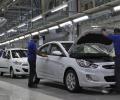
Leading carmakers Maruti Suzuki, Hyundai and Tata Motors reported robust dispatches to dealers in May on the back of strong demand for passenger vehicles across regions, even as the global semiconductor shortage continued to impact production. Mahindra & Mahindra, Kia India, Toyota Kirloskar Motor, Honda Cars and Skoda also witnessed strong demand for their models last month. The month of May also witnessed Tata Motors race ahead of Hyundai in terms of domestic wholesales.
The Auto Component Manufacturers Association of India on Wednesday sought reduction in GST rate to a uniform level of 18 per cent for the entire automobile industry to stimulate demand and help save around 10 lakh jobs, which are at risk due to prolonged slowdown in vehicle sales.

Maruti Suzuki says it has sold at least one car in 418,000 villages.

This comes at a time when Ola is looking to replicate nationally the success of its auto-rickshaw offering in Chennai and Bengaluru.

What will it take for Tesla to plug and play in India? Sector pundits say it's a mix of strategy, getting the price right, timing, the right talent, and above all, patience.

Increasing the duties on auto parts and putting an additional cess on petrol and diesel could drive up costs of vehicles, specially where volumes are low and localisation is not viable.

In doing so, Bajaj has become the first internal combustion engine two-wheeler company to launch an all-electric two-wheeler in India.

Politicians and Twitter warriors around the globe have a new buzzword among them: Net zero. Everyone appears to be keen to state their commitment to net zero, with India providing an outlay of Rs 35,000 crore to achieve energy transition and net-zero objectives in its Budget for FY24, even as the latest and final report by the United Nations' Intergovernmental Panel on Climate Change (IPCC) warned that current efforts are not enough to curb global warming. A number of small factory owners and businesses, however, have pointed out that the transition to net-zero emissions will cost them hugely.

'We try to pick up stocks early and hold onto them for the long term.' 'We are not someone who buys and sells on a daily basis.'

Online food delivery platform Zomato has decided to narrow its focus on three key areas of food ordering and delivery; supplies to restaurants through 'Hyperpure' and quick commerce, company Chairman Kaushik Dutta said on Tuesday. In his address to shareholders at the company's annual general meeting, Dutta said the move was part of strategy to focus "only on areas that have the potential to become meaningfully large businesses ten years from now". In FY22, he said Zomato was able to achieve strong top line growth while keeping its "adjusted EBITDA burn under control", despite multiple challenges such as disruptions due to Covid-19 pandemic, macro-economic uncertainty, rising inflation, fuel prices, among others.

The investment will be made through a joint venture with Toshiba and Denso. The battery is the most expensive single part of an EV.
